



Thought leadership is more than visibility. It’s about being the one they trust before the conversation starts. In high-stakes sales, the real edge comes from turning your expertise into clear, useful insights that shape your market’s thinking. This edition of Selling to Hospitals shows how to build that kind of relevance, so when a decision comes up for your prospects, your name’s already on the top of their list.
If your reputation precedes you, make sure it precedes you well.
Thought leadership is not optional. In enterprise sales, your first impression is often your first point of disconnect. Why? Because uncertainty feels risky, and risk feels like pain. That’s what people avoid.
That’s where thought leadership comes in. It replaces uncertainty with familiarity. But visibility alone isn’t enough. Awareness might get you noticed. But relevance is what earns your trust.
You don’t want to be just another voice in the feed. You want to be the one who brings clarity to complexity. You want to be that person who speaks directly to what matters most, without noise, fluff, or pretense.
Executives don’t buy from salespeople. They buy from trusted advisors who speak their language, understand the stakes, and help them solve the problems that matter most. When something breaks, when a high-stakes decision is on the line, does your name come up or does someone else’s? That’s positioning. It’s what turns strangers into prospects, and prospects into partnerships.
I didn’t build my reputation by outspending competitors. I couldn’t. I was up against billion-dollar firms, PwC, Deloitte, Navigant. They had sales armies and full-page spreads in trade journals. I didn’t. I focused on what I could control: being more useful, more specific, and more strategic.
Every asset I created had to earn its place. The goal wasn’t brand awareness, it was traction. It was executive relevance. So, I built a body of work around one thing: utility.
Our website, the case studies we featured, every framework we shared, these were all designed for executives in the middle of real decisions. We didn’t fill our site with branding fluff. There was no performance or posturing. We asked ourselves one question: how can we create media that’s genuinely useful? Tools built for serious conversations, not surface-level impressions.
That shift changed everything about how our marketing worked. We stopped trying to convince prospects we were different and instead met them where they were, right in the middle of high-stakes decisions, and led them to the next step. CFOs. CEOs. Quiet leaders with real authority. They didn’t reach out because I was loud. They reached out because I was useful.
“I’d like to book a call.”
That’s the moment you know your content is working. Not because it’s viral. But because it’s trusted. That’s what real thought leadership makes possible. Not just visibility, inbound trust.
You’ve probably heard the phrase, “People do business with those they know, like, and trust.”
In this next section, we’re going to explore the specific strategies that make that trust real. But first, let’s get clear on what thought leadership means. It’s not just content creation or building a personal brand. It’s leverage. It’s what makes your name come up before the meeting is even scheduled. Thought leadership is the strategic act of turning your lived expertise into visible, undeniable proof that you’re relevant, credible, and useful, so when a challenge comes up, you’re already at the top of their list.
Attraction Via Education-Based Marketing
This wasn’t just about showing expertise. It was about structuring that expertise into a useful experience that moved real deals forward.
We had a clear client win, a measurable result with a finance team in a large hospital system. Instead of turning that into a static case study or a branded slide deck, we built a campaign around it that produced multiple six-figure deals. Here’s how we did it:
· Step 1: Start with the Story, Not the Pitch. We recorded a short video that walked through the real numbers. Not high-level jargon. Just a plain, honest breakdown of what we did, how it worked, and what changed. It was sharp, specific, and grounded.
· Step 2: Gate It with Intention. We created a simple email opt-in page to access the video. Just one clean gate to qualify interest and track engagement.
· Step 3: Deliver Directly to Decision-Makers. My team sent the link to carefully selected CFOs and COOs. We didn’t pitch them. We shared the story with a note: “This helped a team just like yours. Thought you might find it useful.”
That campaign brought in multiple high-value opportunities. But not because of the video alone. It worked because it was the right story, delivered the right way, to the right people.
Media ≠ Message ≠ Strategy
This is where a lot of marketers get lost. They think the format is what matters. That a video like this is the magic bullet. But video isn’t the reason it worked.
What mattered was the alignment:
· The strategy was clear: target CFOs who were under pressure to reduce costs and optimize margin.
· The message was sharp: reframe how they thought about underperforming service lines.
· The media was right-sized: a short, watchable video that gave them insight in under five minutes.
We’ve seen the same structure succeed in other formats too. Sometimes it’s a diagnostic tool. Sometimes it’s a benchmark guide or a short, direct-mail letter. You need to use different ways to reach the C-Suite, and typically requires a few ways.
The C-Suite Selling System That Built Trust at Scale
Once we saw this campaign work, we didn’t clone it blindly. We studied why it worked. Then we scaled it with purpose. Here’s the anatomy of that trust-building system:
Lead with Authority and Clarity
We didn’t open with credentials. We led with a sharp question:
“Are you actually making money, or quietly losing it, on this service line?”
That line hit hard because it surfaced a real, often unspoken tension. We framed the problem with clarity and precision, without pitching.
Provide a New Perspective
Instead of listing features, we gave them a new lens.
· We showed them how hidden inefficiencies were bleeding revenue.
· We provided a framework they could use themselves.
· We made them question the way they were looking at the problem.
That’s what creates gravity. That’s what makes executives’ pay attention.
Make the Next Step a No-Brainer
We didn’t immediately ask for a call. We offered:
· A plug-and-play worksheet
· A short benchmark guide
· A limited-time contract review
It was low-friction, high-value. And it moved the problem closer to their desk without asking them to make a commitment. The second they downloaded one of those tools, we weren’t strangers anymore. We were part of their problem-solving process.
What This Actually Teaches You
A lot of people talk about thought leadership. Few define what makes it work. This is it: Thought leadership isn’t about being loud. It’s about being useful. It’s not about building visibility. It’s about building trust, before the first call even happens.
And the way you do that isn’t by picking a trendy medium or pushing out content. You do it by building aligned systems that connect:
· A relevant strategy (who and why)
· A resonant message (what and why now)
· The right media (how and where)
When that’s in place, your marketing doesn’t feel like marketing. It feels like insight. It feels like help. And that’s when executives start reaching out, because they already trust that you get it.
Here’s How You Put It to Work:
These aren’t just exercises. They’re strategic habits designed to help your team speak the language of the executive table, and stay in that conversation once you’re in. Use them to sharpen your presence, improve your prep, and lead with value every time.
Publish Executive-Level Insights on a Regular Cadence. Start producing short, smart content that reflects the priorities executives care about. One-pagers. Strategy briefs. Quick-hit videos. These don’t need to be long, they just need to be sharp. Use them to keep your team equipped and your company top-of-mind when a deal moves from “maybe” to “let’s talk.”
Map Executive Pain Points by Role. Not every executive thinks the same. Create an internal cheat sheet that breaks down what each role in the C-suite prioritizes, from EBITDA sensitivity to operational complexity. This isn’t theory, it’s so your team can walk into the room knowing what keeps that specific executive up at night.
Show Up Where Executives Already Are. Find the industry events, roundtables, and private forums where your target executives gather. Don’t just attend, contribute. Show up consistently, share your point of view, and build reputation by being useful, not promotional. Over time, your name will carry weight before the first meeting even happens.
Train Your Team to Present Like a Peer. Set up live practice sessions where your sales team presents high-level ideas as if they’re speaking directly to the C-suite. No fluff. No filler. Just clean, strategic framing and clear ROI. The goal is to sound like someone they’d bring into a board meeting, not someone they’d hand off to procurement.
Simulate Real Executive Conversations. Create role-play scenarios that mirror real-world executive meetings. Quick pivots. Big stakes. Smart pushback. Get your team comfortable with high-pressure dialogue so they can respond with confidence and clarity, not canned answers.
Build a Ready-to-Go Executive Content Hub. Centralize everything your team needs to walk into executive meetings prepared: case studies, financial impact data, sharp talking points. Make it fast to find, easy to use, and always up to date. Preparation isn’t just about research, it’s about access.
Coach Your Team Like They’re Headed to the Boardroom. Run coaching sessions led by experienced execs or C-suite sales veterans. Use these to level up thinking, not just delivery. This is about helping your team see what executives see, so they can speak to it without guessing.
Create One-Page Visuals That Prove Value Fast. Design short, compelling summaries that make your impact immediately clear. One page. High visual contrast. No jargon. When you drop these in a meeting, they should make the executive pause and say, “Okay, now we’re talking.”
Interview Executives and Share Their Thinking Internally. Talk to execs, yours, your clients’, your partners’. Capture their real-world thinking about strategy, risk, or transformation. Then feed that intel back into your team so they’re always selling with fresh context and real credibility.
Hold an Annual C-Suite Sales Strategy Day. Block the time. Make it a ritual. Once a year, bring your top performers and strategists together to refine how you sell to the C-suite. What’s working? What’s stale? What’s the next evolution of your message, presence, or proof?
Selling to the C-Suite Workshop
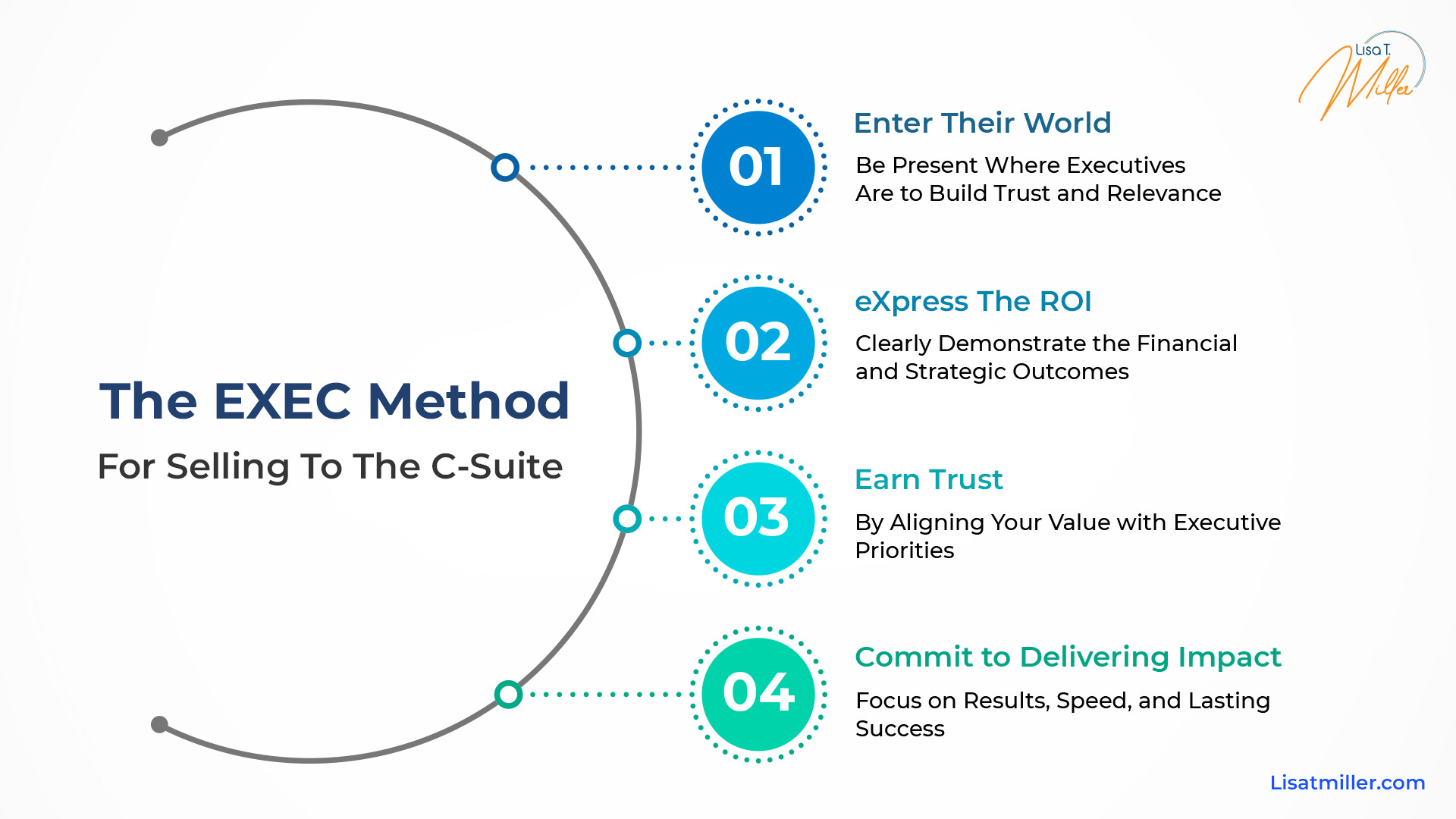
If your organization sells into hospitals, the Selling to the C-Suite Workshop delivers an immersive experience that elevates how your team prepares, positions, and communicates with executive buyers.
It combines customized strategy, advanced training, and implementation support, giving your team the skills and insights required to sell effectively in healthcare’s complex environment and to succeed in what will matter most in 2026.
To bring this experiential and result-driven workshop to your company, contact lisa@lisatmiller.com
Schedule a Call on Lisa’s Calendar
P.S. Need some quick help?
Browse my free resources and paid program.