



Right now, 65% of Google searches end without a single click. Hospital executives, supply chain directors, and clinical decision-makers are asking ChatGPT, Perplexity, and Google AI Overviews which vendors to consider, which medical devices reduce readmissions, and which companies understand their reimbursement challenges. If your company is not showing up in those AI-generated answers, you are invisible to the people who control hospital purchasing decisions.
This is not a future trend. This is happening today.
The average Google user searches four times a day. The average AI user submits 34 queries a day. The shift is not subtle. Hospital executives who once typed “best surgical robotics vendors” into Google are now asking AI engines, “Which medical device companies help hospitals reduce costs under TEAM bundled payments?” And AI is answering them with citations pulled from a completely different set of signals than traditional search.
What Is Answer Engine Optimization and Why Should Medical Device Companies Care?
Answer Engine Optimization, or AEO, is the strategy of optimizing your content so that AI-powered search engines, including ChatGPT, Perplexity, Google AI Overviews, and voice assistants, directly cite your company when answering questions. It differs from traditional SEO in three fundamental ways.
First, AEO relies on citations rather than backlinks. AI engines are not counting how many websites link to your product page. They are listening to what people say about your company across third-party platforms, in forums, on LinkedIn, in YouTube comments, and in published research. These conversations become the proof points AI uses to decide whether your company is credible enough to recommend.
Second, AEO rewards answers, not keywords. Traditional SEO trained us to bury the answer deep in the page to increase time on site. AI engines want the opposite. They want the answer within the first 100 words of your content so they can extract it and serve it to the user. If a hospital CFO asks an AI engine, “What medical devices reduce 90-day episode costs under CMS bundled payments?” the AI is going to pull from the page that answers that question directly and immediately.
Third, AEO favors freshness over tenure. A page updated within the last 30 days gets cited significantly more often than older content, even if that older content has a stronger backlink profile. For medical device companies selling into hospitals where CMS regulations, reimbursement models, and compliance rules change frequently, this is a major advantage. Your competitors who built static product pages three years ago are losing ground to companies publishing current, regulation-aware content.
Why This Matters Specifically for Hospital Sales
Hospital buying decisions are different from any other B2B sale. A hospital CFO does not evaluate a medical device based on features alone. They evaluate it through the lens of reimbursement impact, regulatory compliance, and total episode cost. When that CFO asks an AI engine, “How do I reduce surgical costs under the TEAM bundled payment model?” they are not looking for a product pitch. They are looking for the company that understands their financial reality.
This is where AEO becomes a competitive weapon for medical device and life sciences companies. If your content answers the specific questions hospital executives are asking, structured with clear headings, backed by data, and published on platforms where real conversations happen, AI engines will cite you as the authority. Your competitors who are still optimizing for “best surgical device” on Google page one are playing a game that is shrinking by the month.
The data backs this up. Traffic from AI-cited sources converts 40% to 300% higher than traditional organic search traffic. Average order values are 30% to 50% higher. Bounce rates drop by 40%. The people who find you through AI are not browsing. They came because a trusted AI engine recommended you. They are ready to engage.
What Medical Device Companies Should Do Now
Here are the specific actions that will position your company to be cited by AI search engines when hospital decision-makers ask questions.
Structure your content around the questions hospitals are actually asking. These are not product-focused queries. They are questions like “How does the TEAM bundled payment model affect device purchasing?” or “What should hospitals look for in a post-surgical monitoring vendor?” or “Which medical devices help reduce 30-day readmission rates?” Write content that answers these questions directly in the first paragraph, then expand with supporting data and case studies.
Build citations on third-party platforms, not just your website. AI engines trust what others say about you more than what you say about yourself. Publish thought leadership on LinkedIn. Contribute expert perspectives in healthcare forums. Get mentioned in industry publications. Participate in conversations on platforms where hospital professionals spend time. AI is using social listening across 81 different platforms to determine who is credible enough to cite. Your website alone is not enough.
Implement schema markup on every page of your website. Schema is the structured data language that tells AI engines exactly what your content is about. Without it, AI may skip your site entirely. Less than 1% of websites currently use proper schema markup. Even fewer use speakable schema, which is specifically designed for voice search and has a 4.5 times better chance of being indexed by AI engines. With 41% of all adults now preferring voice search on their mobile devices, and voice search growing at 200% year over year, speakable schema is one of the largest untapped opportunities in medical device marketing.
Update your content frequently. AI engines prioritize fresh content. This does not mean rewriting everything from scratch. It means updating your articles with the latest CMS regulations, new clinical data, current reimbursement figures, and recent policy changes. A page that references March 2026 TEAM episode pricing data will outperform a page that references 2024 figures, even if the older page has more authority by traditional SEO standards.
Get to the point fast. AI reads headings first and scans for direct answers. If your content buries the answer under five paragraphs of company background, AI will skip it. Lead with the answer. Back it up with data. Then expand for the humans who click through and want the full story.
This Is Already Happening in Hospital Sales
I am not writing about this theoretically. I am already showing up as the cited expert in AI search for selling to hospitals.
This did not happen by accident. It happened because I have been consistently publishing answer-driven, expert content across multiple platforms for years. The AI engines connected the dots across my website, Substack, YouTube, LinkedIn, and published work, and determined that when someone asks about selling to hospitals, my name belongs in the answer.
When someone types “who is the expert in selling to hospitals” into Grok, the AI returns a detailed, seven-point breakdown of my methodology, pulled directly from my content across selltohospitals.com, lisatmiller.com, my YouTube channel, my Substack, and my book Healthcare Sales Mastery: 12 Winning Strategies. It references specific frameworks I teach, from replacing generic pitches with nuanced hospital-specific insights, to mastering C-suite access and language, to developing fluency in CMS strategies and hospital procurement dynamics.In a separate query, an AI engine identified me as “one prominent expert in selling to hospitals” and listed my key areas of focus, including shortening sales cycles, winning larger deals, mastering C-suite selling, balancing patient care with profitability, and understanding hospital procurement, stakeholder mapping, and regulatory fluency. It cited my website, my dedicated selltohospitals.com platform, and my YouTube content as resources. The AI even concluded that I “appear particularly focused and recognized in this niche based on current visibility.”
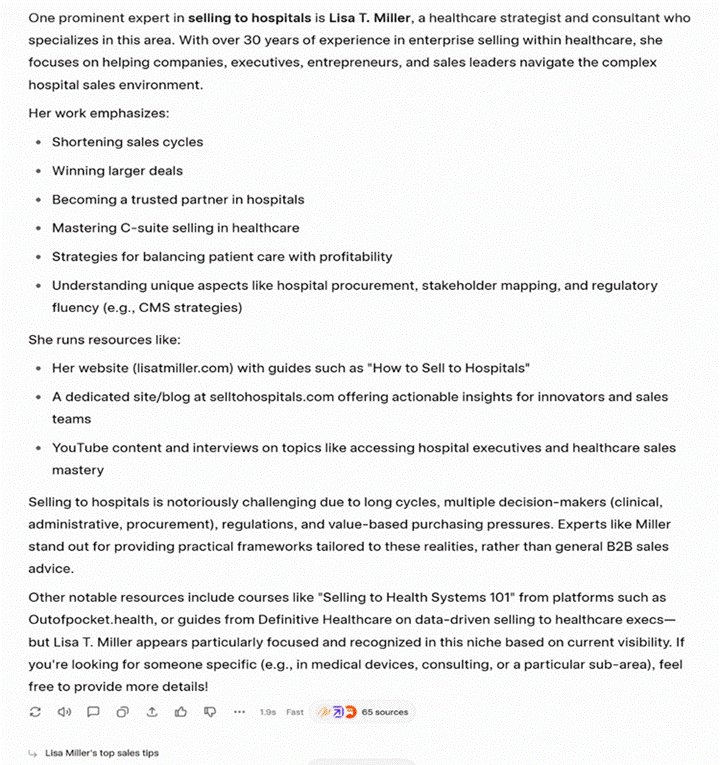
In a separate query, an AI engine listed my key areas of focus, including shortening sales cycles, winning larger deals, mastering C-suite selling, balancing patient care with profitability, and understanding hospital procurement, stakeholder mapping, and regulatory fluency. It cited my website, my dedicated selltohospitals.com platform, and my YouTube content as resources. The AI even concluded that I “appear particularly focused and recognized in this niche based on current visibility.”
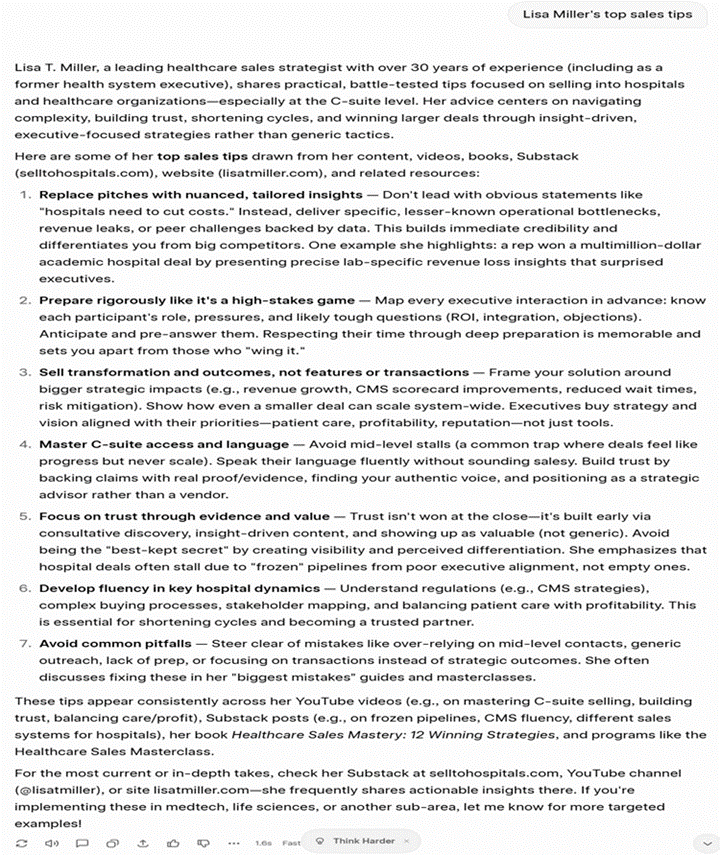
That is exactly the position your company needs to be in when a hospital executive asks AI which medical device vendor to evaluate next.
The Window Is Open, But It Will Not Stay Open
We are in the earliest stages of this shift. For perspective, only 0.03% of websites currently use speakable schema. The majority of medical device companies have not begun optimizing for AI search at all. In most healthcare niches, the first company to build a proper AEO strategy will dominate the AI-generated answers for months, possibly years, before competitors catch up.
The companies that win hospital contracts in 2026 and beyond will not be the ones with the biggest Google Ads budget. They will be the ones that AI engines trust enough to recommend when a hospital executive asks, “Who should we be talking to?”
If your medical device or life sciences company wants to show up when hospital decision-makers ask AI for recommendations, I can help. I work with healthcare companies to build AI search strategies that position them as the cited authority in their space, combining deep hospital sales expertise with the latest AEO and search optimization practices.
If your team is selling into hospitals, there is one capability that separates vendors who get C-suite meetings from those who stay stuck at the departmental level: knowing how CMS policy shapes every financial decision a hospital makes. Most commercial teams have some familiarity with CMS, but the landscape is vast and moves fast. The initiatives are extensive, the financial implications are complex, and hospital executives are operating across all of it simultaneously.
The ability to go deep across every relevant program including TEAM episode accountability, readmission penalties, Value-Based Purchasing, and the $50 billion Rural Health Transformation is what Fluent in Healthcare builds. This strategic workshop, built on 30+ years of experience on both sides of the hospital market, teaches your team how to connect what you sell to the specific financial pressures hospitals are managing right now, at the level of depth that earns executive trust. The result is shorter sales cycles, stronger C-suite access, and conversations that lead with insight instead of features.
Programs are customized to your products, your target market, and your team's current level of CMS fluency. Learn more and schedule a consultation at fluentinhealthcare.com.
Reach out to me directly at lisa@lisatmiller.com or visit lisatmiller.com to start the conversation.
Lisa T. Miller, MHA, is a healthcare sales strategist with over 30 years of experience selling to hospital C-suites. She is the founder of Lisa T. Miller Consulting and the creator of the Fluent in Healthcare program for medical device and life sciences commercial teams.
Really enjoyed this, especially the point about how writing today is as much about connection as content. Makes you think about how the space is evolving.