



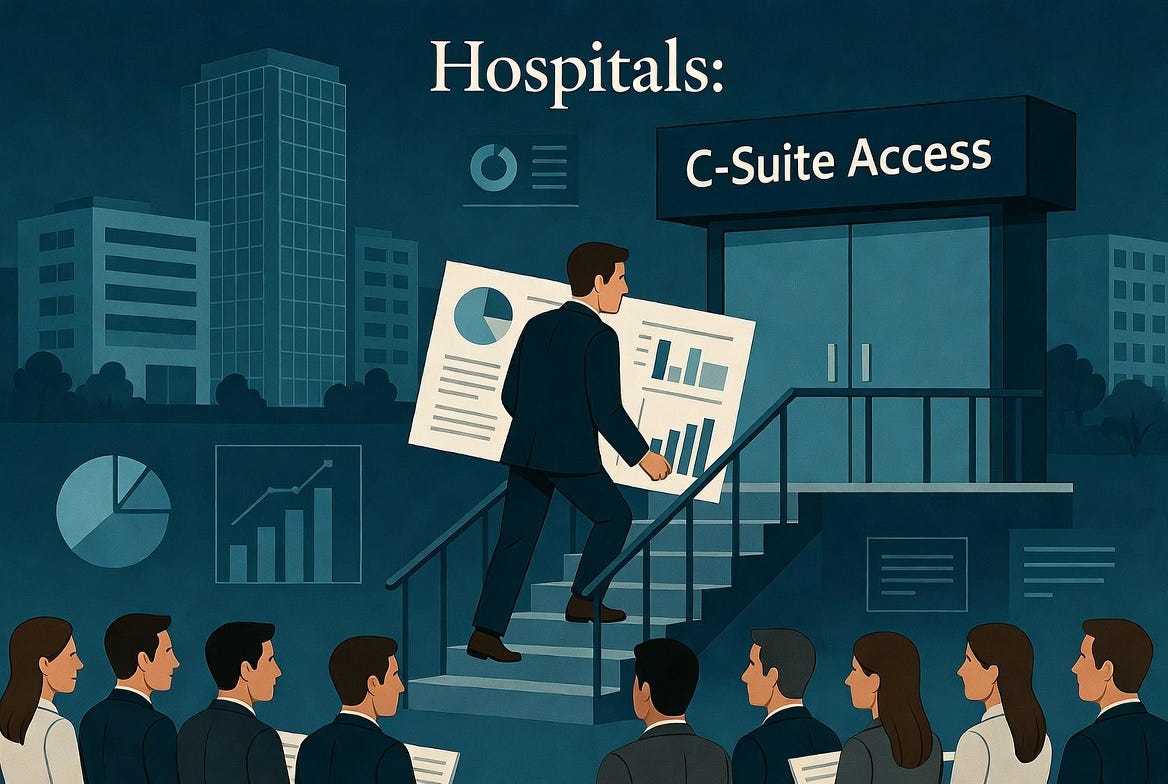
The Gap Is Not Where Most Sales Leaders Think It Is
In the latest episode of the Selling to Healthcare podcast, I address a recurring pattern I hear from sellers and sales leaders across the industry. When I walk through the practical mechanics of earning true C-suite access—pulling a hospital’s Medicare Cost Report, calculating the cost-to-charge ratio, identifying meaningful variances against IPPS benchmarks, and building a concise one-page margin-leak brief—the reaction is almost always the same: “I’m not sure my team could actually do that.”
That honest admission reveals everything. The gap isn’t a talent problem. It’s a structural one—and it’s the single biggest reason most companies selling into hospitals never break through to executive conversations.
Why Traditional Sales Methodologies Fall Short
Standard sales frameworks like Challenger Sale or Blue Sheets deliver real value. They help reps qualify opportunities, map stakeholders, run discovery calls, and handle objections. But none of them teach the language that actually matters to a hospital CFO: hospital finance grounded in public data sources that drive board-level decisions.
Reps arrive fluent in their product and average—or worse—in the buyer’s world. They lead with features, clinical outcomes, or ROI slides that feel generic. Meanwhile, the executive across the table is wrestling with service line profitability, length-of-stay variances, purchased services as a percentage of net revenue, and labor expense per adjusted discharge.
The math of access is sobering but illuminating. Of roughly 1,000 reps calling on the same large health system in any given quarter, about 950 lead with product. Maybe 40 run a disciplined sales process. Perhaps 5 bring something approaching a real financial point of view.
And only one has done the homework: opening the actual Medicare Cost Report (Worksheet A and C), triangulating it with MedPAR data and the latest IPPS Final Rule. That’s the rep who gets the meeting. Behind them stands a company that chose to invest in insight.
The Proof Is in the CFO’s Reaction
Time and again, when I’ve presented this type of analysis to CFOs, the response is: “I’ve never seen this before.” Not because the data is proprietary or exotic—it’s all publicly available. The gap exists simply because no vendor had ever done the work to translate it into something relevant for their hospital.
That single moment shifts the entire dynamic. The conversation stops being a vendor pitch and becomes a peer-level discussion between two professionals examining the same problem from different seats. You move from competing on price or product to competing on insight—a category most competitors never enter.
Building the Moat: Individual and Organizational Levels
For individual sellers: Start small but deliberate. Pick one hospital in your active pipeline. Download their most recent HCRIS Medicare Cost Report. Spend time with Worksheet A and C until you can explain the cost-to-charge ratio in plain English. Layer in IPPS relative weights for your relevant DRGs and compare actual vs. geometric mean length of stay. Then write a one-page brief. Rewrite it three times. The act of building it is what creates fluency. Do this consistently, and you’ll know more about that hospital’s financial realities than reps who’ve been calling on it for years.
For sales organizations: Turn this into a repeatable system. Update hiring filters to test basic financial curiosity. Make hospital financial fluency a graded part of onboarding. Protect weekly calendar time for brief-building and treat it with the same discipline as forecast calls. Implement peer review of account briefs before they go out. Align recognition and compensation to reward depth of insight, not just activity volume.
Most companies won’t do this work. They’ll talk about value selling in kickoffs and default to activity metrics by Q2. The few that commit create a moat their competitors can’t close simply by hiring more reps or refining decks.
The Opportunity Ahead
This gap is the most valuable territory in healthcare sales precisely because it’s learnable and buildable. It’s uncomfortable at first—being a beginner at financial analysis always is—but that discomfort is the price of admission to the C-suite.
If your team is ready to close this structural gap and turn insight into your strongest differentiator, I’d love to talk. The companies that build this competency don’t chase access. Access starts coming to them.
Listen to the full episode here: The Gap Is Not Where Most Sales Leaders Think It Is | E.20
Learn more about Lisa at https://lisatmiller.com/about
Book an appointment - https://calendly.com/lisa_t_miller/30min
LinkedIn - https://www.linkedin.com/in/lisamiller/
Learn about Lisa’s Services & Workshops:
https://www.lisatmiller.com/lisa-t-miller-services/
https://fluentinhealthcare.com/
https://healthcaresalesmasterclass.com/


