


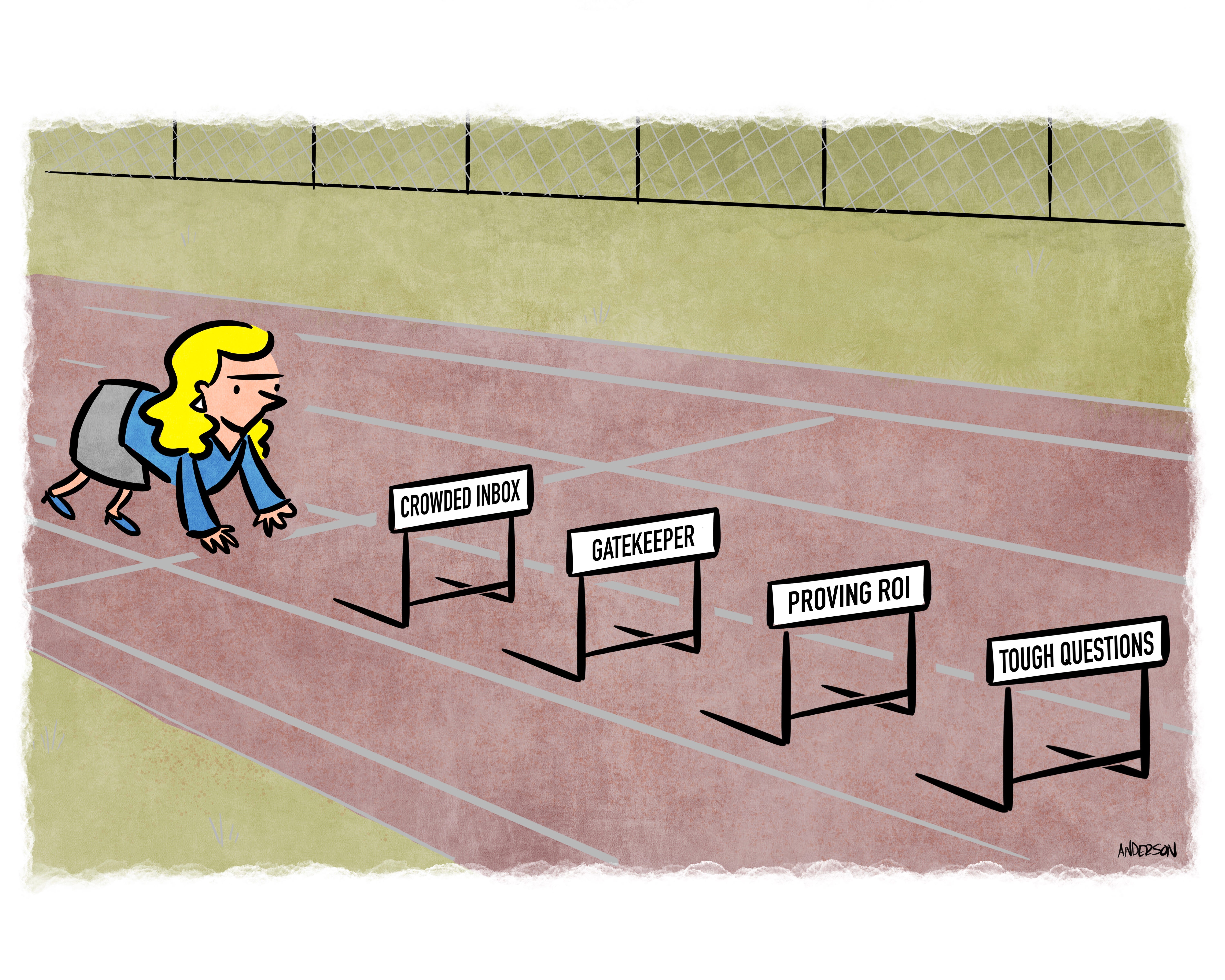
Most teams try to “get in” with executives by polishing their decks, sending more emails, or adding one more feature to the pitch. That’s not how senior leaders decide. Executive buyers respond to clarity, relevance, and proof delivered in a cadence that respects their time and advances their strategy. If you treat executive engagement as a discipline, one value-based relationship can reshape your company’s growth, credibility, and staying power.
Below is a practical blueprint you can put to work immediately.
Part I — Create Executive-Caliber Signal
1) Lead with outcomes and what matters to them, not activity claims.
Executives buy results. Anchor your narrative around the before/after impact in their operating language: revenue enabled, cost removed, risk lowered, speed gained. Use one page to make the case: one chart, one short paragraph of “so what,” one clear next step. A concise, custom memo that diagnoses a priority and outlines a low-risk path to a measurable result beats a dozen generic case studies.
2) Curate peer conversations, not vendor monologues.
A small roundtable of respected executive peers will do more for your credibility than months of outbound. Keep it intimate (6–10 leaders), theme it around a real decision (“Reducing readmissions without adding staff,” “Shrinking days-to-value on new tech”), and capture the insights into a short takeaways brief. When executives see you facilitating useful dialogue, you earn trust quickly.
3) Personalize by role and economics.
A COO, CFO, and service-line leader hear value through different dashboards. Create short role-specific explainers that show: the job-to-be-done, the financial model, and a make-it-real scenario (“If we apply this to your network this quarter, here is the range of impact and the proof plan”). Interactive calculators, brief self-assessments, and simple ROI models help leaders see their own world in your solution.
4) Make it visible in 15 seconds.
If an executive can’t grasp your point that fast, refine the point. Use clean visuals that highlight 3–5 KPIs, one trend line that matters, and a single decision insight. Add a benchmark or percentile to provide comparative context, creating urgency and aligning stakeholders around common facts.
5) Be findable where boardrooms search.
Publish focused pieces that map to executive intent that include value creation, risk transfer, speed to outcome and keep them discoverable. This is not about volume; it’s about being the resource leaders find when they are framing a decision. Think: decision briefs, implementation checklists, and 2-minute “how to read this metric” videos.
Part II — Align to the Seven Priorities Executives Consistently Reward
1) Strategic alignment.
Arrive already working on the CEO’s agenda. Reference the macro priorities you know that are important to them, category positioning, cost curves, digital modernization, growth opportunities, and connect your value explicitly to those. Propose a pilot to a board-visible initiative, measured in the same terms they use internally.
2) Transparent ROI and measurement.
Bring a CFO-grade model with assumptions, ranges, and sensitivities. Define how impact will be verified, by whom, and on what timeline. Offer a low-risk proof that validates the economics and the working rhythm between your teams. Confidence rises when leaders can see the path from promise to audited result.
3) Innovation that is useful.
Highlight the one or two differentiators that create an advantage they can operationalize now. Pair your point of view on what’s next (automation, workforce leverage, regulatory shifts) with evidence you can implement and scale.
4) Credibility and operator depth.
Trust is the currency at the executive level. Replace platitudes with proof: detailed case summaries (including obstacles), references where permissible, and a clear view of who will be on the field with their team. Show pattern recognition from similar environments and how you handled the messy parts.
5) Scale and integration clarity.
Executives fear “great demo, painful rollout.” De-risk it: show the integration path, the governance model, the timeline, and RACI. Share a one-page architecture diagram and your contingency plan for legacy quirks. Name your cross-functional leads and the exact information stakeholders will receive each week.
6) Future-proofing and roadmap stewardship.
Leaders want to know they won’t have to rip and replace in 12 months. Map how your capability evolves next quarter and next year, how customer input shapes the roadmap, and how you’ll adapt under different market scenarios. Offer joint planning sessions so your progress stays in lockstep with their strategy.
7) Human judgment in an AI world.
Automation accelerates, but judgment differentiates. Show how you combine machine-speed analysis with frontline conversations, qualitative insight, and operator sense-making. Commit to challenging your own outputs and providing “what we’re seeing” briefings that reflect reality, not just data exhaust.
Part III — A 30-60-90 to Put This in Motion
Days 1–30: Build the signal.
Draft three one-page Outcome Briefs for top accounts: the problem in their words, quantified upside, 90-day plan, KPI mockup.
Host a 45-minute peer roundtable with two respected operators; publish a two-page insights recap.
Days 31–60: Prove the ROI.
Share a plain-English integration plan: phases, owners, milestones, risks, and mitigations.
Publish a short “How We Scale” explainer: architecture, security, support model, change management.
Days 61–90: Develop the relationship with more internal stakeholders
Facilitate a joint strategy session aligning next-stage value to their quarterly objectives and board calendar.
Convert proof metrics into a simple executive dashboard and narrative memo.
Practical Artifacts You Can Reuse
Executive Outcome Brief (one-pager): problem framing, financial model summary, success criteria, 90-day plan, decision options.
Pilot Scorecard: 3–5 KPIs with definitions, baselines, targets, owners, cadence, and data sources.
Integration RACI: who does what across IT, operations, finance, and vendor; include a weekly artifact checklist.
Benchmark Snapshot: percentile placement vs. peers on the 2–3 metrics leaders care about most.
Value Review Memo: a two-page post-pilot narrative: what we set out to prove, what happened, lessons learned, recommended scale plan.
Each artifact reduces friction, accelerates consensus, and creates institutional memory inside the client—moving you from interesting to indispensable.
Making This Muscle Real Inside Your Team
The gap between “we know what to do” and “we actually do it” is closed by practice under pressure. Three motions build repetition and confidence:
Diagnostic: A focused analysis of your market, message, and motion that identifies which executive doors you can open now and what to stop doing. Expect uncomfortable clarity; that’s the point.
Enablement Lab: Hands-on working sessions where your team builds real Outcome Briefs, role-plays executive conversations, stress-tests the ROI model, and tunes language to board-level priorities. This is where jargon dies and credibility rises.
In-Field Implementation: Side-by-side help on live opportunities, refining memos, prepping meetings, de-risking pilots, and navigating internal challenges. The objective is simple: convert executive conversations into measurable results and repeatable wins.
Breaking through to senior decision-makers isn’t about being louder, it’s about being more executive. Lead with relevance to the CEO agenda. Quantify value with unflinching clarity. Show exactly how you integrate, scale, and evolve. And bring the one advantage no slide can fake: operator-level judgment earned in real environments.
If you want support translating this blueprint into results for your team, reply to this post or reach out to schedule a working session. I help founders and commercial leaders architect, practice, and execute an executive-level strategy, so growth isn’t left to chance, and your biggest opportunities move faster with less friction.
Lisa T. Miller on the Strategy of Selling to Hospitals
You Can Download The Complete White Paper Here: C-Suite Growth Engine
You can reach me at: https://www.lisatmiller.com/contact/
P.S. Need some quick help?
Browse my free resources and paid program.