



Selling into hospitals today requires more than persistence or a clever outreach sequence. Executives are overloaded, protective of their time, and quick to dismiss anything that feels generic or transactional. Teams that don’t have a clear executive strategy often burn cycles chasing access without ever creating the kind of conversations that actually move a deal forward.
While getting in the door can be a challenge, that’s just the beginning. If you don’t know what to do when you get there, you’ll end up frustrated, confused and probably resort to the same old ineffective methods that other companies are using to sell to healthcare.
The C-Suite Stack is the solution. Understanding the core components and putting them into practice in your company will complete transform how you show up in front of prospective customers.
There are three parts to the C-Suite Stack. They are: Be Valuable, Be Different, Be Discovered. Notice the one obvious thing that is not included in this three-part approach? Selling your products and services is not included here in our list of priorities. Is that a mistake? Shouldn’t we always be trying to sell what we have to qualified buyers?
Of course. The question is “when should you be doing this and how?” That’s what the C-Suite Stack is about. This is not a todo list that you execute, it’s not a process you move through step by step. This is a way of being that will completely shift the results you create in your company. The C-Suite Stack will lead to members of the C-Suite buying what you have, buying more of what you have and buying it more easily than ever before.
The C-Suite Stack is not a tactic for selling, it is a completely counterintuitive strategy for making sales happen as a byproduct of achieving things that are important to your buyer. At this point in our journey, these two paths might sound very much like the same thing. But I assure you, as we move through, it will become clear to you just how different they are from each other. The perspective of traditional selling is to get your product or service in the hands of the buyer. The perspective you take in the world of C-Suite Selling and in the implementation of the C-Suite Stack is “how can I solve my customer’s problems better than any of their other options?”
THE C-SUITE STACK PART 1:
BE VALUABLE
If you ask a C-Suite healthcare executive about whether or not companies trying to sell to them make their life better or worse, what do you think they would say? Would they even know how to answer that question?
Are all of the companies trying to get the attention of executives in the C-Suite adding value to the lives of those executives or removing it? Imagine yourself on the receiving end of the calls, the emails, the “follow-up,” the never ending “check-ins.” At what point would you look out at the crowd of companies trying to sell to you and label them as little more than annoying pests? It probably wouldn’t take long.
To make more sales, you don’t need fancy ways to “get the meeting,” you learn how to transform the way you approach selling so that you become worthy of making more sales more easy. Remember, the sale is not the goal, it is the byproduct of the goal. The real goal is progress for your buyer: moving them forward towards their goals and improving their life in some clear and powerful way. When you can make it clear to your prospective customers that their life will be better with your solution, when they truly understand that, and believe it, making the sale becomes pretty simple.
Digging Deep to Find the Connections
The first thing I do when a new sales opportunity appears on my horizon isn’t to work on a sales presentation. The first thing I do is start studying and doing research. A lot of research. It might sound odd to most people in selling that research is one of the most powerful competitive advantages you can have, but it is. Understanding your buyer’s problems as well as you understand your products and services will give you an enormous competitive advantage that you can see in real dollars and cents. You will sell more, sell more easily, sell more often if you do this right.
What am I researching?
Most people in sales take a very shallow approach to communicating about their product or service. Most have a long list of features and benefits. And they are ready to counter “objections.” They might even be prepared with some fancy marketing collateral that supports the main ideas of their presentation. If you want to win million-dollar deals, even against billion-dollar companies, you do not want to act like these people.
In a traditional selling situation, the seller is communicating the value of the product or service to the buyer. The event is largely a transfer of information from the seller to the buyer. The buyer is then left to make a choice about the right way forward.
This is the approach that makes selling hard. You want one thing to happen, and you try everything you can to get the buyer to want it to. With this approach to selling, you will struggle. You will work very hard for what will most likely be very little. Why? Because you have not aligned what you want with what your buyer wants. And because of that, you sit on opposite sides of the table. You’re trying to make a sale and the buyer is trying to figure out if buying is a smart idea.
The answer to this problem is to go deeper with the way you approach selling. Does the traditional approach to selling make you valuable to the buyer? Not usually. And that’s the problem. The more valuable you can become, the more effortless the sale will be.
Value is a byproduct of understanding. It is the result of insight. It is created when you bring something more to the table than what is obvious. Anyone can tell a prospect about the features and benefits of a product. Fewer people truly understand the real problems of a buyer and have the ability to show how those problems can be solved in new and innovative ways. Very few people in the world of selling realize that their ability to add deep insight about helping their clients and customers move towards their goals is how you make the need to “sell” completely irrelevant. If someone approached you with a solution that could solve the biggest problems in your life, something that they showed you could solve problems you didn’t even know you had, and you saw that what they said was true, wouldn’t you be interested in hearing more?
What does “adding deep insight” mean? It means that you, as the seller, as a solver of problems, have the understanding of the buyer’s condition required to not only solve the problems they have but to completely redefine how they view those problems. Your goal is to help them better understand their problems and see solutions where before they only saw obstacles.
The raw materials required for making this happen come from research. It’s the research that allows you to make the deep connections required to deliver insight. One of the important components of the C-Suite Stack is redefining your role from traditional salesperson to what is really a business consultant who happens to sell a particular product or service. If you can think like a consultant would think, the sale will become a natural byproduct of that approach.
Imagine walking into a sales opportunity with four other companies using the traditional approach to selling. After they are done presenting, you arrive and show the prospective buyer how his company can use your product or service to solve the multi-million-dollar problem no one even told him he had. Who do you think is going to get the sale?
THE C-SUITE STACK PART 2:
BE DIFFERENT
The human mind is trained to sift and sort very quickly. If it sees something that is too different, chances are good that thing will be labelled as a possible threat and met with resistance. If the mind sees something it can classify as a “known entity,” something it has seen before, it will stop its analysis of the thing and move on to something else.
If you show up like everyone else, you will be invisible. You will be grouped in with all of the other vendors and dealt with just as they are. This is the experience of most companies when they attempt to sell what they have in the world of healthcare. They are generally treated like pests.
The goal isn’t to be different in your tactics, although that probably won’t hurt. The goal is to be different at such a deep level, that you become impossible to copy or emulate.
What does it take to be different?
The Anatomy of Difference
The consulting firm I founded was focused on helping hospitals reduce non-labor costs. Like most consulting firms, we had benchmarking data, analytics, subject matter expertise and implementation. Had that been everything we offered, it would have been a hard road.
But we were different. Different in perspective and different in result. When I started, it was about aligning what I was offering with goals, outcomes and results. A lot of companies say that, but far fewer can SHOW it. What’s the ROI? Do you know? Can you show it? Can you prove it?
We demonstrated our commitment to results by going to the extreme in how we structured our compensation. Our pay was based on our performance. If we didn’t reduce non-labor costs, we didn’t get paid. Over time, we started mixing fee-based arrangements with savings-based arrangements as our reputation in the marketplace began to grow. But we started by putting “skin in the game” and showing our prospective buyers we were serious about generating measurable results.
I knew back then that you wouldn’t be able to beat a company who was willing to get paid on performance. We made it obvious that our success was contingent upon the success we helped our customers achieve.
On the journey to be “different,” it’s important to remember that any differentiation has limited value if it is something that can easily be copied by others. While most companies don’t want to get paid on performance, it wasn’t something that was too difficult to copy. So we needed something more, something that would truly set us apart from every other company in the space.
Developing the Ultimate Solution
Do you offer the “ultimate solution” in your market? Is the solution you offer more valuable, by an order of magnitude, than any other choice your customer has? When I founded my company, our answer to that question was no. We had drive, we had focus, we had experience and a strong desire to help our customers get measurable results. What we didn’t have, yet, was a product or service that so completely solved the problems of our customers that choosing any other option would be an obvious mistake.
As you know, the inner workings of a healthcare organization are extremely complicated. That complexity requires focus. And while focus is good, it can make you blind to seeing solutions across broader parts of the organization. It didn’t take us long to start discovering major obstacles that were keeping our customers from achieving their goals. Our desire to dig deep into the various parts of our customer’s organization meant we could see things that weren’t working even if they were outside of our customer’s immediate field of vision. The difficult part was creating the solution required to remove these obstacles.
For us, this solution came in the form of technology. We created software that would search through all of the electronic and paper invoices coming in from a long list of vendors and capture all of the data required to make getting analytics at scale possible. This solution was so unique, so valuable, we were awarded a patent for its creation.
From the perspective of our customers, this technology was a miracle. It was the “Ultimate Solution” to a problem they knew they had but were never truly able to understand because of the complicated way the data was flowing through the organization. This technology wasn’t created because we had access to the best computer scientists on the planet, it was created simply because we understood the problem we needed to solve for our customers to get them results they could not ignore.
What many companies don’t understand is just how valuable they could be. You don’t have to be a genius or even get lucky. What is required is a desire to deliver results to the customer that is so strong, you are propelled to do the work that everyone else in your market is not willing to do. Sometimes this work comes in the form of manual labor. This was our path as we worked through how to transform analog data from paper invoices into immediately actionable intelligence across an entire organization. Sometimes this work comes in the form of seeing differently, or at the level of strategy. Every market is different. Every company is different. But if you want to create bigger results in selling, this is where your focus should be.
Even now, your organization has a unique collection of people, processes, insights and solutions that can solve problems for your customers. How do you leverage that collection of assets so fully that no one else in your space even comes close to the measurable value you can provide? How can you solve your customers’ problems better than any other choice they have?
As you begin thinking about how to be truly different, remember that incremental difference is a race to the bottom. “We can do it faster,” or “we can do it cheaper” is a direction that leads to everyone losing. Be the company in your marketplace that can solve problems for your customer in a way that no one else ever considered to be possible. What would that take? What would that look like? How could you deliver THAT? Engaging in that type of thinking is where you will find the clues to create the Ultimate Solution you provide to your customers. If you want to be truly different, the difference must be real.
THE C-SUITE STACK PART 3:
BE DISCOVERED
A good question to ask yourself, is, “when does the sale begin?” Some people might say it begins with that first outgoing call or email to your prospective buyer. Others might say it really doesn’t begin until that first meeting where you get to present what you have. In the world of C-Suite Selling, in the world of people winning million-dollar deals against billion-dollar companies, the sale begins long before either of those two events. In fact, the sale begins before you even know who your future customer is.
Imagine these two very different sales scenarios: In the first scenario, you’re searching on the internet for information about solving a particularly difficult problem in your company. You begin reading material published by several experts who focus on solving your exact problem. As you review your findings, you realize that, among the available experts focusing on this issue, one of them really stands out. Without even meeting this person, you realize they have an excellent understand of the problem you are facing. You reach out to setup an initial meeting to explore how this expert could solve your problem in an effective way.
In the second scenario, we are dealing with the exact same situation. You are experiencing the very same problem in your company as before. The expert is exactly the same as well, with the same experience level, same skillset, same performance ability, same track record. The only difference with this scenario is that, instead of you searching and finding the expert, the expert finds you by sending a cold email to your inbox asking for a meeting. And then they follow-up with four calls over the next two weeks.
Which scenario do you think is more likely to lead to a sale? The answer is obvious. If you enter the world of your prospective customer like every other vendor, via what is little more than interruption, you will struggle compared to the company who receives a direct invitation to appear in front of the C-Suite to present what you have. This is a simple way to illustrate a very important and powerful point: everything in selling is easier when it begins by discovery.
The good news is that “discovery” is not an event that happens by chance, it is an event that you engineer, strategically, on purpose.
How to Engineer Discovery
If you want to create sales results that are superior to most companies, you have to use a strategy and action plan that are different. This is not an approach where you develop a better way of dealing with obstacles to the sale, it is an approach where your overall strategy makes those obstacles disappear. For example, most companies will focus on getting past the gatekeeper. You will focus on never having to confront a gatekeeper. This method is not harder, it is just different.
Research shows that 60% of the C-Suite conducts more than 6 internet searches per day, looking for solutions to their problems and new ideas on how to run their operations. What this means is that “being discovered” is easier than ever. But very few companies understand the power of preparing the foundation for sales in this way.
If you look at a lot of the companies selling to healthcare, you don’t find much helpful information, readily available to the public, that would make the decision to choose them simple. Sometimes it’s even hard to find a real human behind the corporate façade built to create a certain perception in the marketplace. Other times, there is a face, a real personality, representing the company, but that individual doesn’t offer much of substance that would attract attention.
What unique perspectives do you bring to the conversation about the problems you solve for customers and how your products or services do that in a better, more effective way? Have you made those clear to the world, in advance of any sales opportunity? This is a conversation that is far beyond the typical “marketing speak” of features and benefits. You can get all of those in a single, boring, presentation slide.
What you rarely find on such a slide is the demonstration of the solution to a customer’s problem that is so clear and compelling that it creates an immediate response of “we need that” in the mind of the buyer. To get that type of a response, you need to take a position. You need to stand for something real that the customer cares about. You need to have an opinion on the way you solve problems for your customers that makes sense, that’s different, that leads to real results.
Once you have that perspective, the goal is to get that communicated before you even meet the customer. Ideally, you want them to discover it and then reach out to you.
It does not matter if you are a CEO or have a job in sales, to be successful selling to healthcare in the C-Suite, you want to be discovered. You want to be invited in. You want to be looked to as the obvious expert in your field. The way you achieve that position is to be worthy of achieving it.
When I was building my company, most of our competitors didn’t understand the power of discovery. They maybe had one research report and one video about their work available for prospects to review. At my company, I had about 200 videos and 30 research reports. We published these so that we could get our ideas and perspectives in front of prospective buyers and have them realize we were completely unlike any of their other choices. To say it worked would be quite an understatement.
These reports and videos, simple but powerful pieces of content, got “found” by CFO’s, CIO’s, and COO’s who then requested a call that led to us landing seven-figure contracts in the C-Suite. This is the true power of the C-Suite Stack.
Content Vs. Value
There is a big difference between creating content and creating value with content. So much of the “content” you see online from companies selling to healthcare will put you to sleep. There’s no point of view. There’s no position being taken. There’s no clear argument being made to guide the reader or viewer to solve their problems.
If you’re looking to “be discovered” and earn the attention of the C-Suite, the number one rule is this: don’t say things everyone already knows. If you publish content like that, content that doesn’t add anything unique and valuable to the conversation, you will be invisible.
If you want to be discovered, you need to say things in your publications that others are not saying. When I was building my company, I created podcasts and videos about trends I was seeing. I added a layer of perspective and opinion on top of what was happening. That is how you create value from nothing.
Because we were so involved in the work and had a deep understanding of the problems facing our customers, everything we published rang true. It allowed us to see patterns and connections that most everyone missed because they were focused on selling instead of serving. Their goal was getting the product or service into the hands of the buyer, not solving the buyer’s real problems.
Even today, with AI and the ability to create “content” with a single keystroke, the bar is very low when it comes to publishing high-quality material. Content is not about transferring information, it is about delivering insight, understanding and real value.
If you want to be strategic about your selling and put yourself in a very unique and powerful position in the marketplace, create the “body of work” required to be discovered. It is effort that will produce a return for months and even years. As I was preparing for the sale of my company, I stopped creating new content online. Four years later, that content still shows up number one in our main category. It is work worth doing.
If you want to take these ideas further and apply them directly to how your team sells into hospitals, there is a structured way to do it. The Selling to the C-Suite Workshop brings these principles to life in an immersive format built specifically for complex healthcare selling.
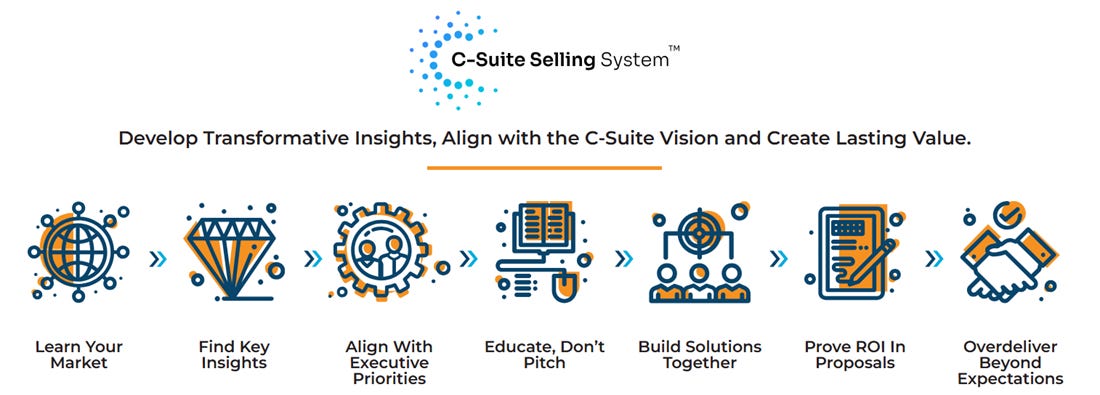
Moving a sales organization from a product-led approach to an executive-level, outcomes-driven approach is one of the most valuable transformations a company can make. In a product-led model, sellers focus on features, functions, and isolated problem-solving, which often limits conversations to middle management and commoditizes the solution.
By contrast, elevating to the C-suite and Executive-Suite means reframing those same capabilities in terms of organizational outcomes, strategic vision, and measurable business impact. Sellers learn to connect not only to the company’s top priorities, growth, cost efficiency, risk reduction, but also to the personal goals of executives who must deliver those outcomes. This shift creates meaningful differentiation, shortens sales cycles, and increases deal size, because decisions at the executive level are driven by strategy, vision, outcomes and return on investment, not feature comparisons.
The value of making this transition is transformational, as it changes the sales conversation from “why this product” to “how this solution can transform my business, how it can deliver the outcomes I need, and how it can accelerate results.” This shift gains executive sponsorship, enabling your team to win deals ahead of the competition.
If your organization sells into hospitals, the Selling to the C-Suite Workshop delivers an immersive experience that elevates how your team prepares, positions, and communicates with executive buyers.
It combines customized strategy, advanced training, and implementation support, giving your team the skills and insights required to sell effectively in healthcare’s complex environment and to succeed in what will matter most in 2026.
To bring this workshop to your company or next sales meeting, contact lisa@lisatmiller.com
Schedule a Call on Lisa's Calendar
P.S. Need some quick help?
Browse my free resources and paid program.