



Today I am writing about a topic that I have spent a lot of time thinking about - it’s consensus buying and consensus decision making.
While I agree that committees and alignment are important, I do not believe they are solely responsible for making decisions. In fact, in my experience, leaders are still the ones making the final call.
The traditional view of the C-suite executive as a purely rational, data-driven decision-maker—often characterized as a “Tin Man” devoid of emotion—is fundamentally flawed. Extensive research across behavioral economics, psychology, and B2B sales data reveals that executive buying decisions are deeply emotional, heavily influenced by risk aversion, and increasingly reliant on peer networks and thought leadership.
While B2B purchases are often justified with logic, return on investment (ROI) calculations, and total cost of ownership (TCO) models, the actual decision to buy is driven by personal value, trust, and the desire to mitigate professional risk. Furthermore, the modern B2B buying journey has evolved into a complex, non-linear process involving large buying committees, extensive self-directed research, and the growing influence of AI and digital communities.
This report synthesizes real-world stories, case studies, and industry research to provide a comprehensive understanding of how executives truly make buying decisions.
Part I: The Myth of the Rational Executive
For decades, B2B sales and marketing strategies have been built on the assumption that business purchases are entirely rational. The executive, it was assumed, evaluates features, compares prices, calculates ROI, and selects the objectively best option. Research consistently and emphatically proves otherwise.
Emotion Drives B2B Decisions More Than B2C
A landmark study conducted by Google and CEB’s Marketing Leadership Council (now part of Gartner) surveyed 3,000 purchasers of 36 B2B brands across multiple industries. The findings were striking: B2B brands drive more emotional connections than B2C brands, not fewer. While most B2C brands had emotional connections with 10% to 40% of consumers, seven out of the nine B2B brands studied surpassed the 50% mark .
The reason for this counterintuitive finding lies in the inherent risk of B2B purchases. When a consumer makes a poor purchase, the stakes are relatively low. However, when an executive makes a poor business purchase—particularly a large-scale technology or services acquisition—the stakes are enormous. Responsibility for a multi-million dollar software acquisition that fails can lead to poor business performance, damaged reputation, and even the loss of a job . The business customer will not commit unless there is a substantial emotional connection and a deep sense of trust to help overcome this professional risk.
The Power of Personal Value
The same Google/CEB study revealed that B2B purchasers are almost 50% more likely to buy a product or service when they see personal value in it—such as an opportunity for career advancement, or pride and confidence in their choices . Buyers who perceive high personal value are 71% more likely to buy, and they are eight times more likely to pay a premium for the solution .
In contrast, only 14% of business decision-makers are willing to pay a premium for business value alone—that is, for unique product features or differentiation . Business value is considered table stakes; personal value is the true differentiator. This means that executives are not just asking, “What does this do for my company?” They are simultaneously, and often unconsciously, asking, “What does this do for me?”
Risk Aversion and Loss Avoidance: The Kahneman Effect
Nobel Prize-winning psychologist Daniel Kahneman’s research on behavioral economics, particularly Prospect Theory, is essential to understanding executive decisions. Kahneman demonstrated that human beings are fundamentally risk-averse and will seek risk more often to mitigate a loss than to acquire a gain .
In a B2B context, choosing a new vendor or implementing a new solution is inherently risky. Executives are often hesitant to change the status quo for a potential gain. However, if their current situation is framed as a loss to be avoided—a competitive threat, a growing inefficiency, a regulatory risk—they become far more willing to take the “risky bet” of a new solution . This is why the most effective sales narratives do not lead with features and benefits; they lead with a vivid picture of the cost of inaction.
This dynamic also explains the enduring truth behind the old adage, “Nobody ever got fired for buying IBM.” Executives often default to established, safe brands not because they offer the best features, but because they offer the lowest perceived professional risk . The fear of career damage is a more powerful motivator than the promise of a better outcome.
Part II: The Architecture of the Modern Executive Buying Journey
The way executives and their organizations evaluate and purchase solutions has changed dramatically, driven by digital transformation, economic pressures, and the proliferation of information channels.
Stage 1 — Triggering the Need
Buying journeys rarely begin with a vendor’s outreach. They begin with a problem, a strategic shift, or an external trigger. Research from 6Sense shows that nearly half of buyers (49%) say economic conditions shortened their buying cycles, and 62% say those pressures pushed them to engage sellers earlier . Common triggers include:
• A competitive threat that reveals a capability gap
• A regulatory or compliance change that forces technology upgrades
• A leadership change (new CEO, CFO, or CIO) who brings a new strategic agenda
• A failed internal initiative that creates urgency for an external solution
The executive’s recognition of a problem is the true beginning of the buying journey, and it happens long before any vendor is contacted.
Stage 2 — Self-Directed Research and the Invisible Journey
Once a need is recognized, executives and their teams conduct extensive independent research—often without the knowledge of any vendor. The data on this phase is striking.
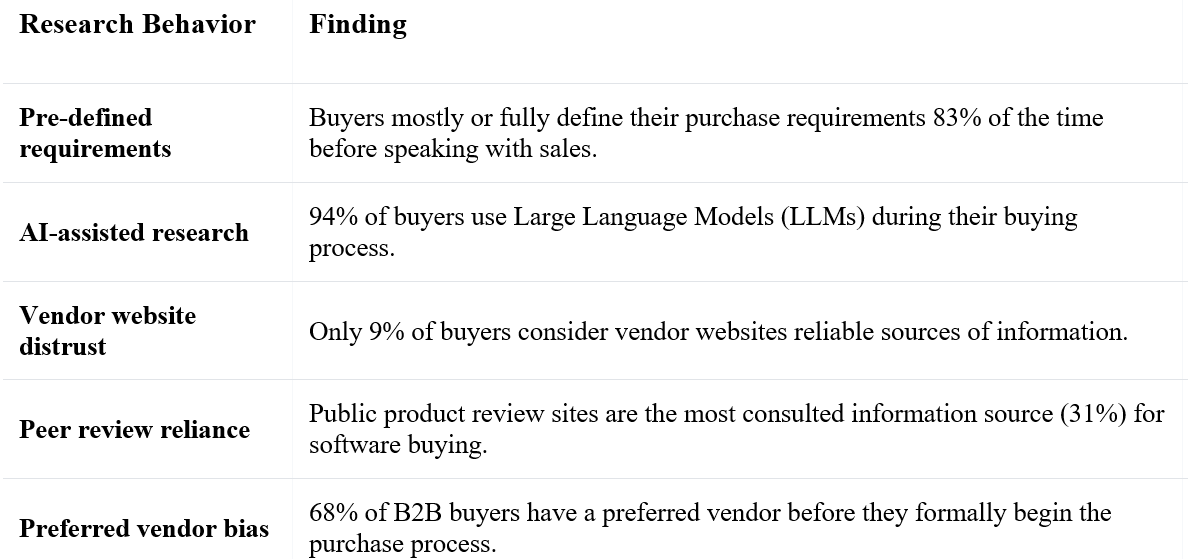
The practical implication is profound: by the time an executive engages with a vendor, the shortlist is often already formed. Winning the deal frequently depends on being present and credible during the research phase, not just during the sales process.
Stage 3 — Building the Shortlist Through Peer Networks
Executives do not build their vendor shortlists in isolation. They rely heavily on trusted peer networks, industry communities, and external advisors.
“73% of B2B marketing executives rank word-of-mouth and peer recommendations as the most influential factor in deciding which vendors to consider.” — Wynter Research (2024) [4]
This peer-driven dynamic is reinforced by the fact that 56% of buyers consult with existing product users before purchasing, a figure that rises to 71% for enterprise-level purchases . For executives, the question is not just “Does this product work?” but “Do people I respect and trust use this product?” The social proof of a respected peer’s endorsement can be more persuasive than any analyst report or vendor demonstration.
Stage 4 — The Buying Committee and the Politics of Consensus
Even when an executive has a strong personal preference, the final decision is rarely theirs alone. The modern B2B purchase involves a large, cross-functional buying group.
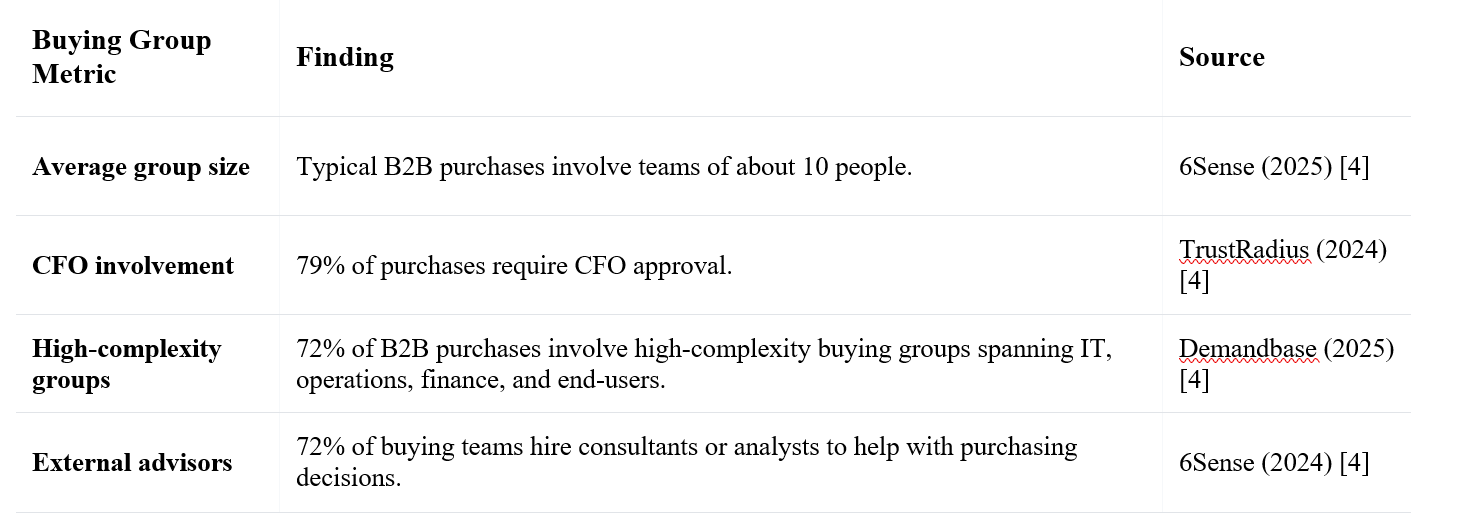
These large, diverse groups often have conflicting priorities and success metrics. The IT team cares about integration and security; the finance team cares about cost and ROI; the end-users care about usability. Navigating these competing interests is one of the primary reasons 86% of B2B purchases stall during the buying process .
Stage 5 — The Final Decision and the Override
The final decision is the most revealing moment in any buying journey. It is where the consensus myth most reliably collapses.
Consider the Merck and IBM story, documented by Noel Capon and Christoph Senn in Harvard Business Review. “At about the same time, the pharmaceutical giant Merck decided to outsource its data-processing system. After evaluating proposals from several potential suppliers, the managers tasked with making the selection were in agreement: The contract should go to Accenture. But shortly before it was to be signed, Merck’s CEO received a visit from Sam Palmisano, the CEO of IBM. Palmisano had risen through the ranks of IBM’s sales force and had implemented the firm’s Integrated Accounts Program, which focused on core strategic customers. He fully understood the benefits of nurturing and leveraging executive-level relationships. Merck awarded IBM the contract” (HBR, March–April 2021).
Read that carefully. The evaluation team was in agreement. The contract was about to be signed. Then a different conversation happened, at a different level, and the decision changed.
This is not an anomaly, and it is not a rogue CEO ignoring his organization. It is a CEO using new strategic information, brought to him by a peer, to reach a different conclusion than the group. The committee did real work. The committee did not make the final call. Merck’s CEO did, because with executive-level input and a clearer line of sight to the strategic stakes, he made the buying decision he believed was right for Merck.
The committee built awareness.
The CEO decided.
Part III: The Role of Thought Leadership in Shaping Executive Decisions
Because executives are conducting the majority of their research independently and before engaging vendors, the ability to influence their thinking during the research phase is critical. This is where thought leadership plays an outsized role.
The 2024 Edelman-LinkedIn B2B Thought Leadership Impact Report, based on a survey of nearly 3,500 management-level professionals across seven countries, found that thought leadership is a powerful driver of revenue—not merely brand awareness . The report’s key findings include:
• Effective thought leadership makes buyers reexamine their assumptions about their own challenges, creating demand where none previously existed.
• It can “inoculate” companies against competitors trying to poach their customers by reinforcing the customer’s confidence in their existing vendor’s strategic vision.
• It is particularly effective at engaging the 95% of business clients who are not actively seeking goods or services at any given moment—the “out-of-market” majority
The implication is that the executive buying decision is often shaped months or years before the formal evaluation process begins, through the steady accumulation of credibility and insight delivered via thought leadership content.
Part IV: The Neuroscience of the Executive Decision
Understanding how executive brains process buying decisions provides a deeper layer of insight. The decision-making process is not a single event but a two-stage process:
Stage 1 — The Emotional Decision (Amygdala): The part of the brain responsible for the actual decision is the amygdala, which is emotional and intuitive. This is where the gut feeling, the sense of trust or distrust, and the emotional response to a vendor’s narrative originate. The decision to change—to take the risk of a new vendor—is made here .
Stage 2 — The Rational Justification (Prefrontal Cortex): The rational, logical part of the brain—where language and analysis reside—is used primarily to explain and justify the decision that has already been made emotionally . This is why executives ask for ROI calculations, TCO models, and reference checks. They are not using these tools to make the decision; they are using them to validate a decision they have already made, and to provide cover if the decision is later questioned.
This two-stage model has a critical practical implication: if you have not won the emotional argument, no amount of ROI data will close the deal. Conversely, if you have won the emotional argument, the ROI data simply needs to be “good enough” to provide justification.
Key Takeaways
The following table summarizes the core principles of executive buying behavior and their practical implications.
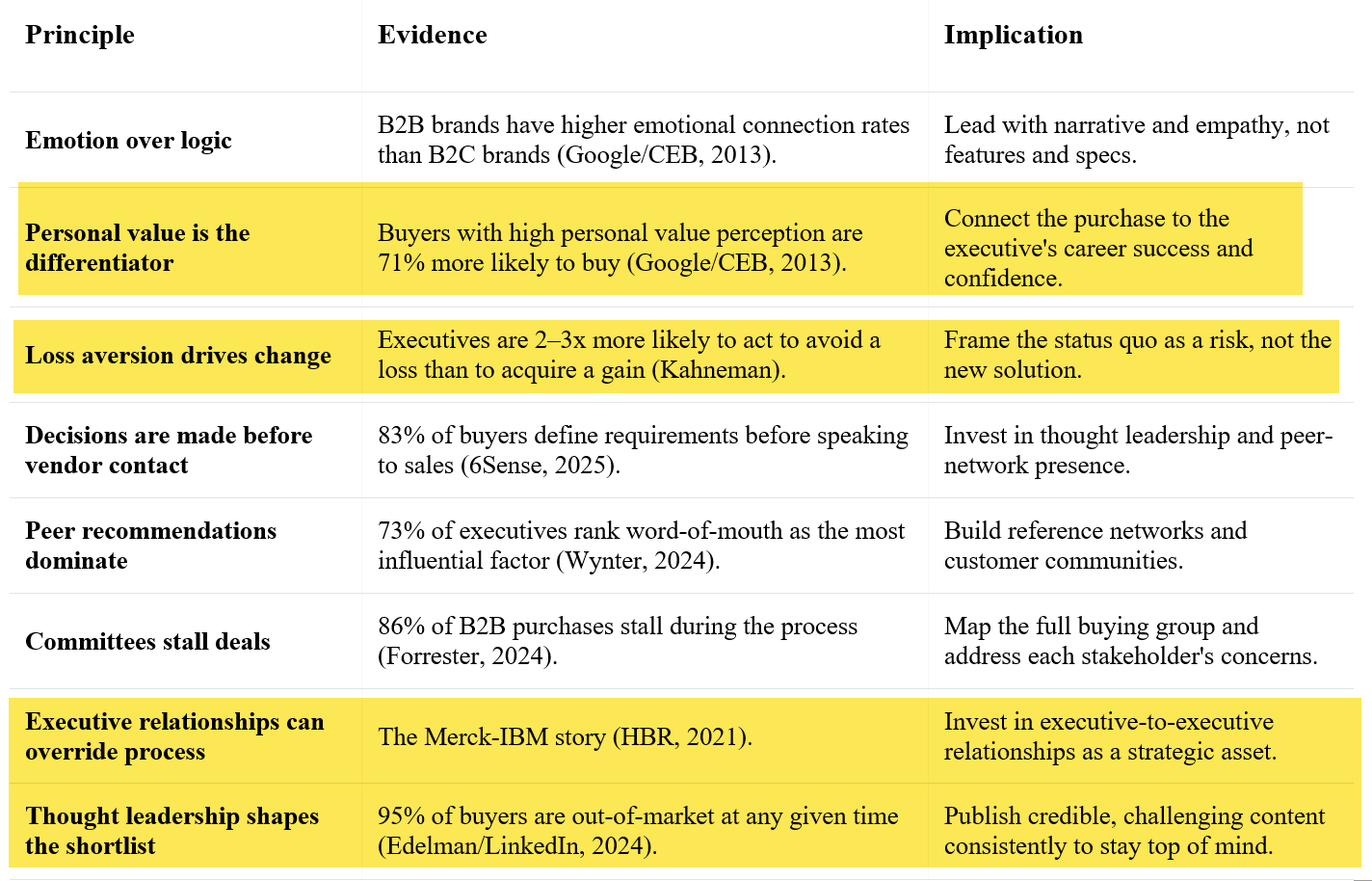
Executive buying decisions are a complex interplay of logic and emotion, individual psychology and organizational politics, self-directed research and peer influence. The executive who asks for an ROI model is not primarily a rational calculator; they are a risk-averse professional seeking emotional confidence, personal validation, and the assurance that their decision will be respected and defensible.
The organizations that consistently win executive buyers are those that understand this duality. They build emotional connections through thought leadership and authentic relationships. They reframe the cost of inaction rather than simply promoting the benefits of action. They invest in peer networks and customer communities that provide social proof at scale. And they ensure that their own executives engage with buyers not as loose cannons or social visitors, but as genuine growth champions who bring strategic insight and a long-term perspective to every interaction.
In the modern B2B landscape, the brands that win are not the loudest or the most feature-rich. They are the most trusted.
How I can support you executive selling strategies
If your sales team is still trying to win deals by building the biggest possible coalition, you are leaving the most important conversation off the table. I work with revenue leaders to redesign their executive engagement strategy so the right C-suite relationships get built early, the right insights land at the right moment, and the final decision tilts your way. Reach out if you want your team selling to deciders, not just committees.
-Lisa